01
Assessing your limits, identifying feasible goals
(9 topics
)
With the basics planned and a fundamental image data management strategy set up, it is time to evaluate what you can and can’t provide for users in a foreseeable timeframe. You can manage expectations and implement valuable steps towards data FAIRification while acknowledging the constraints you are facing.
Investing in research data management (RDM) can significantly enhance the value of scientific data (Griffin et al., 2018; Zaritsky, 2018). However, the added value must be balanced against realistic limits and constraints. Hence, a pragmatic focus on available resources is essential. Small, actionable steps toward FAIR image data management can be more effective than being stuck trying to build a top-notch data handling infrastructure from the start. Many core facility imaging scientists face substantial challenges when building an RDM infrastructure for their users. Available resources and support differ widely between institutions and countries. In some cases, core facilities might struggle with little support and limited hardware, while for others, the task of choosing from the possible arrays of hardware and software tools, provided locally or in collaborative networks, might be overwhelming and labour-intensive. It is therefore essential to recognise the respective limits of what can realistically be implemented and to focus on pragmatic, achievable steps. For example, improving FAIR metadata annotation for newly generated data can already provide substantial value, even if retrospectively curating existing datasets is not yet feasible. The guiding principle is: start with manageable improvements and scale them as resources, expertise, and institutional support grow. In this chapter, we outline how to assess available capabilities, stakeholders, and resources, and then focus on practical measures that can be implemented even with limited support, including file organisation, naming conventions, and metadata curation.
In the previous steps, we have established that asking questions and starting with a plan should be prioritised over opportunistic short-sighted action. Based on your needs analysis from understanding user requirements and making your initial considerations (see episode 3: Start with the basics), it is time to identify which resources you can leverage regarding hardware, software, and personnel. Reaching out to various stakeholders and pitching the basic ideas of improving imaging RDM in your facility and your institution is your first step (Schmidt et al., 2024). Partners on the research side you want to rely on are those who acknowledge you as more than a mere service provider, but a partner trying to solve problems in RDM to the mutual benefit of your facility and their research process. Their role will be to try out novel RDM approaches, knowing that drawbacks and limitations will be part of the process, instead of expecting that you deliver an RDM ecosystem serving all their needs at once. Teaming up with two to three pilot phase researchers who iteratively test and support new RDM structures will help you align closely with user needs without being overly focused on individual research peculiarities.
In most cases, you will not operate hardware, server configurations, and software stacks all by yourself. It is essential to find partners in your IT department who will support you in identifying available hardware resources and usage conditions, for example, virtual machines on central IT systems that you would be allowed to manage. Once again, it is essential to establish a collaborative spirit in teaming up to solve problems instead of expecting merely a service offering. Find out about: What storage stacks are available and how much storage space? Is storage scalable, and how is it accessed? How is the hardware wired within the institutional network regarding data safety and backups? What costs should be expected?
Tip 1: Start with a consultation with the central RDM team At many institutions, RDM is a focus of central institutional departments such as academic libraries or even central RDM teams with data stewards. If these are available at your institution, reach out to find support, leverage synergy, and to identify which responsibilities are assumed by each stakeholder. For example, a general basic introduction to RDM practices might be covered centrally, while you can focus on the specific RDM aspects for imaging data on top.
Tip 2: Consult relevant institutional offices early It is also recommended to reach out to central offices responsible for legal aspects for at least an initial consultation. These include, for example, law departments and innovation management to discuss information security, contractual frameworks, and data protection. While avoiding being overwhelmed by legal constraints from the beginning, it is essential to understand which perspectives these stakeholders bring to the discussion, which can make you aware of stumbling blocks you want to avoid while keeping legal aspects in mind to seek targeted support on matters once they become relevant for you in the process.
Tip 3: Build institutional support While researchers and colleagues from IT and libraries are most important initially, once a core team is found, you should seek the backing of your institutional management. Find out if there are larger strategic interests or policies which you want to or should align with. Introducing yourself as a team that is there to help serve these interests by solving RDM issues at your institution instead of merely asking for institutional funding helps to prepare the ground for a long-term perspective. If improving RDM solves institutional goals and strategy to support excellent research, make sure to take these aspects into consideration to establish yourself as a pillar of your institution’s success at large, even beyond the pillar that you very likely already are by making sure that your core facility runs properly. The difficult part is to strike the balance between taking on even more responsibilities without having to rely on the same limited resources in the long run. Identify what is possible under which conditions. That means: Besides finding out external constraints, be prepared to identify your own limits as well. If institutional support regarding funding for staff or hardware is not currently available, try to receive strong institutional support in identifying and applying for external funding resources depending on your country and research funding environment. Table 1 summarises essential questions and stakeholders to assess your limits. Overall, these first steps should help you identify limits at three levels:
Hard limits: legal prohibitions, security requirements, unavailable storage capacity, or activities for which nobody can assume responsibility.
Current capacity limits: insufficient staff time, expertise, equipment, or funding that could potentially be changed.
Chosen scope limits: deliberate decisions to support only certain users, data types, or workflow stages initially, and only expand when the required additional resources become available (see episode 3: Start with the basics).
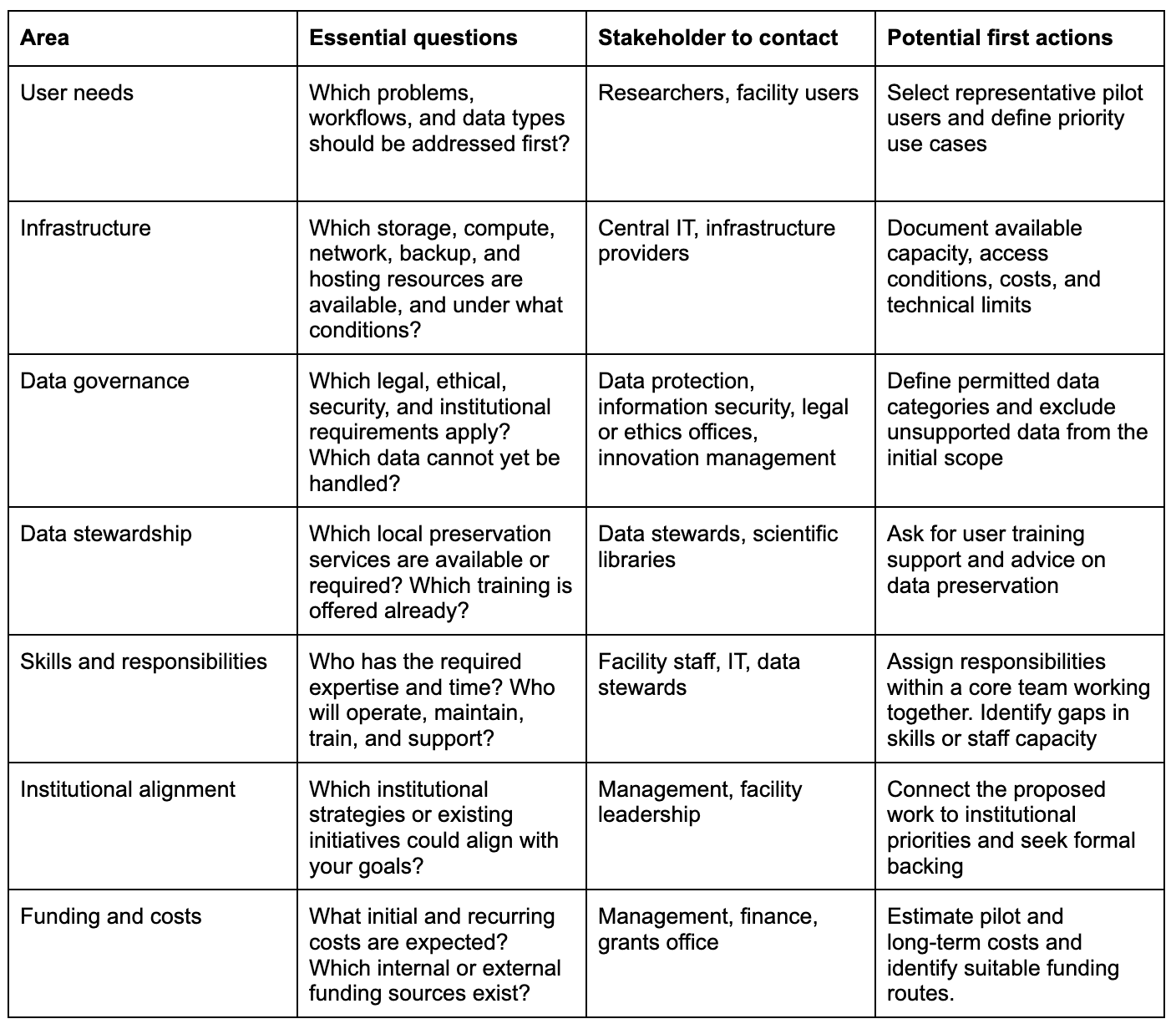
With your (initial) limits in mind, let us focus on pragmatic but powerful first actions towards improving RDM which are associated with little or no costs, but can already showcase benefits of good RDM practice for research data handling: establishing proper folder organisation, file naming convention, and minimum metadata curation practices.
For facilities that rely on file hierarchy systems on drives, a first step towards FAIRification involves best practices in folder organisation, file naming, and metadata annotation using README files or sidecar documents (Korir et al. 2024; Jannasch et al. 2024). A common approach in file naming is to utilise a “tokenising” strategy. Tokens within file names are short, defined character sequences separated from each other by an underscore. For technical reasons, it is recommended to avoid special characters ($, %, §, µ, etc.) and spaces. Often, file names may start with a date in a standardised format followed by the essential information about the data file. Tokens may also include internally defined identifiers for researchers in the lab and/or for the specific experiment that it belongs to. An example is shown in Figure 1:
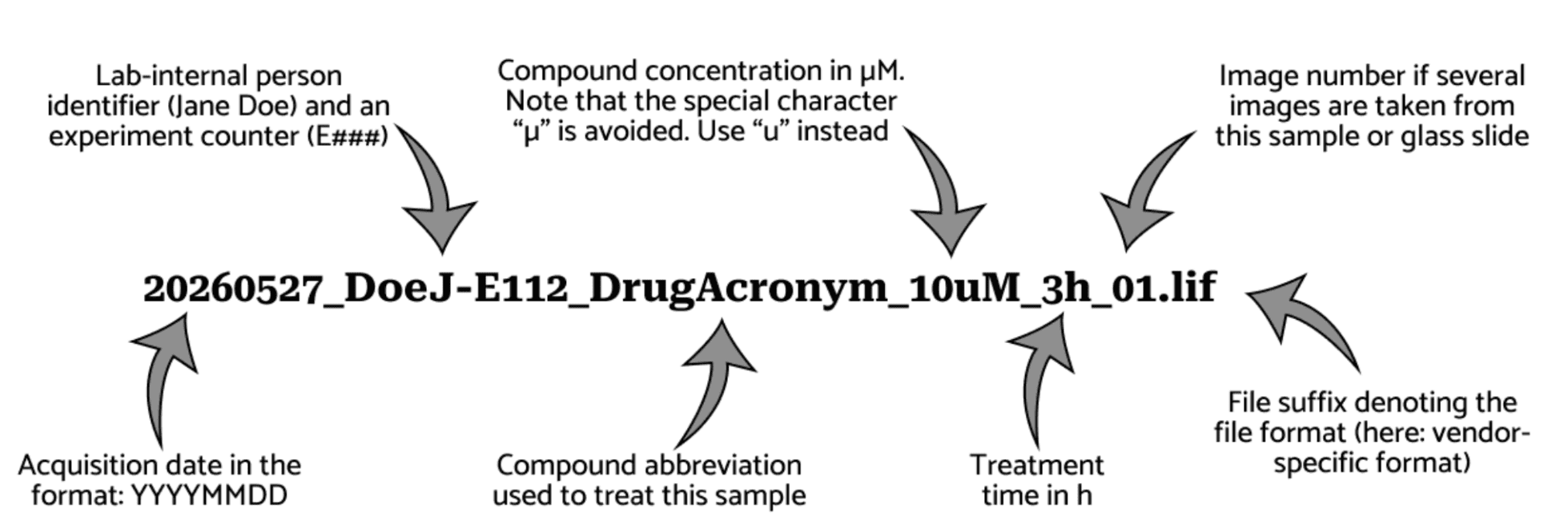
Fig. 1: A simple file naming convention scheme, where essential metadata about the image is contained in the file name itself, separated by an underscore. This strategy is called tokenising and allows extraction of metadata information from the file name. Note that empty spaces and special characters are avoided. A README file can provide the required information about each token’s meaning for a given dataset.
Metadata is crucial for FAIR data. When dedicated data management systems are not available, a plain-text sidecar file adhering to community standards can be a means to facilitate interoperability and reusability. Standardising metadata, especially for experimental conditions, is essential. The metadata headers often included within an imaging file typically lack such experimental information unless it was added within the acquisition software by the experimenter. This information would include, for example, cell culturing conditions, status of the cell line used, batch numbers of chemicals, or similar. While providing expertise on discipline-specific metadata standards for all users might be beyond what is feasible for core facility managers, selected examples for larger user groups might be a start. For instance, neurobiology researchers might use the BIDS-Microscopy standard (Bourget 2022). Where no field-specific standard exists or can be offered, REMBI (Sarkans et al. 2021) can be adopted as a bioimaging-specific checklist. REMBI is not “a standard” in the sense of a specific file format. It offers a structured approach to essential information and useful terminology to describe a bioimaging experiment. As such, REMBI contains both modules that apply to a study with many experiments altogether as well as metadata items describing specifics at the level of individual images. REMBI can, thus, be implemented in tabular formats (CSV files, Excel sheets, etc.) or in software allowing structured map annotations. (e.g., Adamant-generated JSON files, etc.). If resources permit, installing an image data management platform like OMERO on self-managed hardware is an option (Moore 2008; Allan 2012). Here, structured annotations in the form of Key-Value Pairs and Tags can assist in REMBI-based annotation. The use of persistent identifiers (PIDs) for certain metadata entities (e.g., ORCID and ROR for persons and institutions, or DOIs for digital assets) is a valuable basis to start with and expand from. A variant of REMBI is also available for high-throughput microscopy (Hosseini et al. 2023). Finally, curating metadata in compliance with REMBI will greatly facilitate a researcher’s ability to submit data to the BioImage Archive (BIA) and link the original, published data to the respective peer-reviewed publication (https://www.ebi.ac.uk/bioimage-archive/submit/).
Notably, many of the above-mentioned aspects can and should be considered already before an experiment is even started. Plan ahead for your data management to make your life easier in the long run (see episode 2: Start early with a Plan). Importantly, educating yourself and your users about bioimaging research data management is essential. Self-education through online courses is a possible option to some extent, but a global initiative for hands-on RDM training, including platform installation, usability, and troubleshooting for core facility staff, will be crucial for global FAIRification of bioimage data (see also: https://rdmkit.elixir-europe.org/bioimaging_data). This effort can be supported by international collaboration, such as via the image.sc forum or Job Shadowing and Exchange of Experience programs from bioimaging networks (e.g., Global BioImaging, BioImaging North America, Latin America BioImaging, Euro-BioImaging, etc.) (Kemmer et al., 2023, Swedlow et al., 2021). Such a pragmatic start could lead to collaborations for further development and grant opportunities.
A considerable limitation for data handling might stem from data protection regulations, which must be understood and followed. However, implementing compliance with privacy protection policy might not be feasible immediately and is only planned at the start, which in turn leaves you with hard constraints, since data privacy protection is a legal obligation. If the facility cannot meet these requirements, it must not accept or process the affected data until an institutionally approved workflow is available. Some imaging data, especially when stemming from clinical or preclinical settings, have to be handled under strict legal and institutional requirements that cannot be easily implemented in some environments. On a case-by-case basis, first determine whether data are subject to privacy/data-protection requirements; then take the time to establish an institutionally approved workflow. In the beginning, it might be possible that only genuinely anonymised data that no longer fall under those requirements can be handled.
Knowing your limits requires more than recognising that resources are scarce. The larger and more diverse the environment, the more complex the task of implementing FAIR image data solutions can become. For instance, long-term archiving of cold data may require meeting the metadata, format, and transfer requirements of institutional archival services, which are oftentimes offered by academic libraries. Legal and data privacy offices may impose additional conditions, while different research fields within the institution might have unique storage and computing needs. Consider that institutions may follow a strategic focus, such as participating in initiatives like the Excellence Initiative in Germany, the National Roadmap in the Netherlands (NL-Bioimaging), France, Denmark, the National OMERO Image Data Resource Initiative in Canada, etc. A sustainable, integrated RDM solution should align with and support the institution's high-level strategy, thereby strengthening the facility’s strategic position as well. When central institutional services are part of a core facility’s RDM strategy, it is crucial to integrate the constraints and goals of various stakeholders, which can influence the feasibility of certain solutions. Additionally, communicating the RDM needs of an imaging facility to central services can help align their strategic planning with the facility's requirements. However, several of these aspects can be taken into account during planning, and envisioned as long-term goals for expanding the efforts (see episode 7: Progressively increase your efforts), while focusing at first on immediate wins from a reliable best practice approach with awareness about its limitations (see episode 5: Focus on immediate wins).
The take-home message here is: A realistic analysis of both constraints in terms of missing resources and skills, as well as realistic expectations about what can be achieved, will help move things forward. But there is a lot that is possible to foster FAIR data handling even with sparse resources. Thus, managing realistic expectations on the user’s side will also become easier, ultimately avoiding frustration. Researchers usually value efforts to advance their RDM capabilities and improve the institutional services when they know what to expect without overpromising about what the intended RDM strategy will enable them to do.

This project has been made possible in part by a grant from the Chan Zuckerberg Initiative DAF, an advised fund of Silicon Valley Community Foundation.
