August 2026 – What would it take to establish and sustain a biomedical imaging facility for at least ten years—with just US$1 million to get started? Global BioImaging’s Sustainathon Challenge asked imaging specialists around the world to develop a long-term strategic plan.
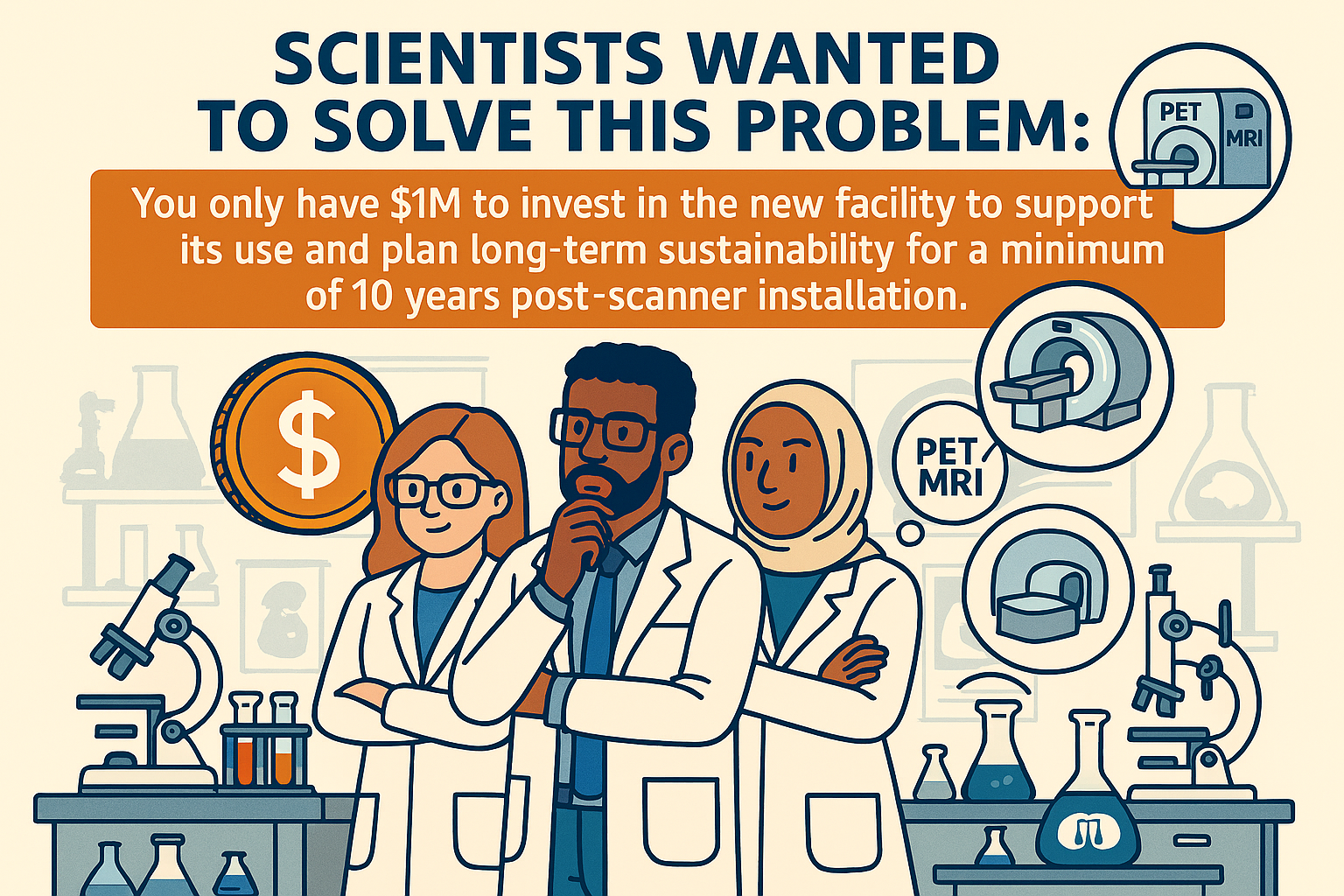
Biomedical imaging facilities, spanning clinical and pre-clinical applications, face specific challenges when it comes to instrument access, data management, and financial and operational planning.
To spark discussion and bring together challenges and solutions from the global community, GBI’s Biomedical Imaging Working Group, chaired by Linda Chaabane, Graham Galloway and Adriana Tavares, came up with a creative idea: a Sustainathon Challenge inviting biomedical imaging specialists from around the world to develop a realistic, long-term model for establishing and sustaining an imaging facility. Participants had to consider not only the scanners themselves, but also the people, finances, data and infrastructure needed to keep a facility running.
The challenge highlighted a fundamental reality: access to an instrument is only the beginning. The long-term success of an imaging facility depends on sustainable models for equipment maintenance, staff recruitment and retention, data management, user engagement and financial planning—and the priorities and constraints can look very different in different parts of the world.
Three teams were selected as winners or runner-up and presented their approaches during an international GBI webinar.
- The high-resource setting winner, Aishwarya Mishra, Early Career Researcher in Imaging and Drug Delivery and Deputy Manager of the Preclinical PET Imaging Facility at the University of Edinburgh, developed a hypothetical facility called the Multimodal Preclinical Imaging Facility (MPIF). The model is centred on balancing equipment, people, outreach and data. It accounts for the gradual increase in facility usage as a new service becomes established, while building in strategies for equipment maintenance and upgrades, staff development and retention, and active engagement with researchers. The approach also incorporates environmental considerations and a tiered data-storage model based on FAIR principles.
- The low-resource setting winner, Adesola Emmanuel Adepoju of the University of Ibadan and the SMART Africa Initiative, proposed a hypothetical facility called UI/UCH-Ibadan. The team took a deliberately different approach to the US$1 million starting budget: rather than investing in new scanners, they proposed upgrading an existing CT and ultrasound fleet at University College Hospital, supported by a solar microgrid to address unreliable power—a major cause of equipment failure. Their model combines equipment-as-a-service contracts, resident training, AI-enabled task shifting, research partnerships and an open-source data infrastructure. The goal is to make the facility self-sustaining within three years and revenue-generating within five. Their central message is simple: “No scanner democratizes imaging by itself. People democratize imaging.”
- The runner-up, Daniel Amaya, Preclinical Imaging Officer at the Translational Research Institute / DB Imaging in Australia, proposed a hypothetical facility based on a tiered fee-for-service model, with around 40% of operational costs subsidised by the host institution. Alongside academic and clinical users, the facility would build longer-term partnerships with industry, offering tailored service packages and technical support in return for more predictable revenue. The model also places strong emphasis on staff development, data management, training and external engagement, including an annual symposium supported through sponsorship.
Although the three proposals differ considerably, they share an important lesson: sustainable imaging infrastructure is about much more than funding a scanner. Each model had to consider how to generate income, maintain equipment, retain expertise, manage data and adapt to changing user needs over time. At the same time, the solutions show that there is no single model for sustainability: what works in a well-resourced research environment may look very different from what is needed where unreliable power, equipment maintenance and access to trained specialists are the primary barriers.
Watch the webinar recordings to explore the three models and consider the question for your own setting: What would it take to make an imaging facility truly sustainable?
From challenge to action
Inspired by the challenges and solutions brought up through the Sustainathon, GBI’s Biomedical Imaging Working Group is now preparing a community-driven, joint publication on sustainable biomedical imaging facilities. The aim is to capture the challenges faced by imaging facilities worldwide, explore the consequences of leaving these challenges unresolved, and bring together practical solutions—including those developed through the Sustainathon.
We invite members of the global imaging community to join the Biomedical Imaging Working Group and contribute to this effort. By combining experiences from different regions and resource settings, we can build a clearer picture of what imaging facilities need to thrive—and develop evidence and practical recommendations that can be taken to funders, institutions and other stakeholders.
- Watch the Sustainathon webinar recordings – discover the three winning approaches to building sustainable imaging facilities: Biomedical Imaging Platforms Sustainathon Winners | Global BioImaging Working Group
- Join the Biomedical Imaging Working Group – contribute your experience and help shape the joint publication: https://globalbioimaging.org/working-groups/biomedical-imaging-community
- Read GBI’s publication on data management challenges in biomedical imaging – a previous GBI Working Group publication based on community discussions and perspectives: https://link.springer.com/article/10.1038/s44319-025-00652-w?utm_source=rct_congratemailt&utm_medium=email&utm_campaign=oa_20251203&utm_content=10.1038%2Fs44319-025-00652-w
This article was written by Sophie Winter from Global BioImaging.